Showing posts with label Stuart Court. Show all posts

Saturday, August 23, 2008

Stuart Court, Chapter Two

Prior to moving into Stuart Court, the imposing apartment house at the entrance to Monument Avenue, I decided to rent a carpet shampoo machine and do some other general cleaning while my place was still empty. I pulled up in the circular drive at the front of the building and unloaded the carpet cleaner, and before I could take off to find a parking space an elderly - but sprightly - black gentleman dashed out to my car and began lugging the machine into the building. I was alarmed, because he looked like he was a thousand years old, and told him I would carry my stuff in as soon as I found a parking space. He would have none of that, and so he hauled my things into the building.

Mark was one of several black employees at Stuart Court, and he usually worked nights and weekends. During the week, two women acted as hostesses. I quickly learned that I had entered a time warp at Stuart Court, and that many of the old women who lived there treated the staff like servants (or worse). Mark was accustomed to hauling packages inside for the residents.

There were two halves inside one unified front as far as the physical layout of the building. Basically, the building was actually two apartment towers with separate sets of elevators. All of the even-numbered apartments were in the northeast wing, while the odd-numbered apartments were in the southwest wing. The elevators were, incredibly, still hand-operated, so there were two hostesses by day. Rosa staffed my side of the building, and at night Mark handled the whole building. This arrangement probably worked fine until young folks like me moved in.

I'd come in late at night, half-lit, and ring the bell to get into the building. Eventually Mark would appear, half-asleep, to take me up to my floor. Mark told me that he was eighty-six and also worked a day job. I'm sure he was accustomed to sleeping at night at Stuart Court, with only the occasional interruption if an elderly tenant had to call an ambulance in the wee hours.

Dead on his feet, Mark would propel the elevator toward the sixth floor, usually overshooting the goal, then we'd lurch down too far, and I'd step up or jump off just to get on firm footing. I always felt bad about waking Mark up late at night, but that's just how it worked. I couldn't run up and down the stairs all the time.

It was nice having day staff available to accept packages while I was away at work. There was also a dry-cleaning service who visited the building at least once a week, and I could leave a check with Rosa for Mr. Collins, and she would place my clean garments on hooks in the mail room. At the time, I wore a lot of dry-cleaned clothing to work, and this was a real time saver.

After awhile, the old elevators were replaced with new automatic lifts, and the night porter was no longer needed. The day hostesses were kept, but residents got keys to the front door for the evenings.

As the older tenants were removed to nursing homes or cemeteries, the lifestyle at Stuart Court gradually changed. Sadly, the building was sold to a careless owner, and a few years ago this once-proud building was featured on the local news because of the poor condition of the building. The new owner did not seem to care that he possessed a piece of history designed by one of the lauded architects of luxury homes in the early half of the last century, William Lawrence Bottomley.

Below is an excerpt from a review of a book, The Architecture of William Lawrence Bottomley, by Susan Hume Frazer:
Refined country houses, gracious urban dwellings, posh Broadway cafés, exotic nightclubs, and a high-rise apartment building that, 80 years after its construction, is still considered the epitome of tony living in Manhattan, these are among the many achievements of William Lawrence Bottomley, one of the best American architects of the first half of the 20th century. During his 40-year career, Bottomley designed and executed over 180 commissions for his clients. An uncompromising perfectionist with refined taste, he oversaw virtually every facet of his projects, from interior ornamentation and decoration to the surrounding landscape design.

Saturday, July 5, 2008

Stuart Court, Chapter One

One of my favorite former residences is a 1920's apartment house on Monument Avenue. I moved into Stuart Court when I was in my early twenties, and I felt like I had truly arrived when I took possession of my sixth floor apartment. When I first left my parents' home, I moved into a spacious but decrepit house with three roommates. In less than a year, I moved to an apartment with one roommate, and about a year later another relocation placed me in my own small apartment in a modest twelve-unit building in the Museum District.

One summer, Suzanne and her roommate Andy decided to move to Richmond after classes ended. They were both students at the University of Virginia in nearby Charlottesville, and the two came to Richmond to hunt for an apartment. I helped them look for a home, and we took a look at an apartment at Stuart Court. The apartment was unsuitable for them, but perfect for me, since it only had one bedroom. I realized that I would have to act quickly to claim this unusual opportunity, so I arranged to sublet my small two-bedroom place to Suzanne & Andy.

When Stuart Court was built in 1924, it was the sole high-rise apartment building on swank Monument Avenue. Today, it is still only one of two. The stone pediment above the front doors is carved with STVART COVRT. I was enchanted with the apartment as soon as I saw the living room, which was spacious and had lovely wall sconces instead of overhead lighting. My favorite feature in the room, however, was the Murphy Bed hidden behind double-doors. The bed had arched matching headboard and footboard when pulled down from its hiding place, and provided an instant guest bed. This solved the one-bedroom problem, since I often had visitors from out of town. Although very practical, it also added a touch of whimsy to the apartment. Scenes from old Laurel & Hardy movies flashed through my mind, but the bed never sprang back into the wall in the night trapping an unsuspecting sleeper.

The dining room was small, but seemed roomy because of built-in cabinets and two walls of knee-to-ceiling casement windows. The room was also five-sided, which added to its charm. Since my sixth-floor dwelling was three storeys above any nearby building, there was usually a good breeze and always a panoramic view. I could easily see the city's baseball stadium, and on Independence Day my guests and I could watch the fireworks from my dining room table.

Another valuable feature, unusual for apartments in Monument's historic district, was the abundance of closet space. There were five good-sized closets, which was a luxury in a one-bedroom unit from this era. I also had storage space in the spooky, rambling basement of the building, and I will describe this cavern in another chapter about Stuart Court.

The galley kitchen was small, but made efficient by ample glass-front cabinets with pull-out cutting boards, and doorways to both dining room and hallway. Although the kitchen was smaller than the one in my previous apartment, it was more thoughtfully designed and usable.

The building was sturdily built with poured-concrete walls, both inside and out. An axe-murderer could have been hacking up my neighbor as she screamed for help and I wouldn't have heard a thing. My apartment was a serene oasis high above Monument Avenue. When I first moved into the building, the upper floors were reached by hand-operated elevators which required a twenty-four hour staff, including two uniformed hostesses by day and a night porter. Life at Stuart Court was like a step back in time, and I will write more about the building, the renowned architect, and the eccentric residents and staff on another day. Day to day life at Stuart Court was anachronistic when I lived there in the early 1980's, and, although the building still stands, this lifestyle is now part of the building's magnificent past. I am very fortunate to have lived there before its notorious decline.

Accompanying photographs:
Top: Stuart Circle, showing the statue of J.E.B. Stuart on lower right and, above the statue, Stuart Court's south wing and part of the central portion of the building.
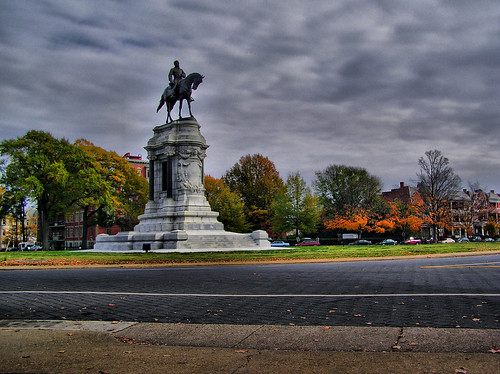
Middle: Robert E. Lee's monument on Lee Circle, one block west of Stuart Court
Bottom: Stuart Court as it appears today.