 Somewhere around here in the House of Planet Bill, there's a box containing all of my report cards and other school records. It's probably in the guest room, a.k.a. junk room, ironing board room, lower attic, and someone-else-could-use-this-so-don't-just-throw-it-away room. There is a bed in there somewhere, so I usually call it the guest room.
I don't need to look at my elementary school report cards to know what the teachers carefully noted on most of them. Little cautionary messages like "Billy has trouble paying attention in class" and "Billy stares out the window and daydreams." Today, I would probably be saddled with a diagnosis of Attention Deficit Disorder and drugged into illusory compliance. I was usually simply bored to distraction by the slow pace of instruction. I also liked to daydream.
History lesson were especially wearisome. Good Lord, how many names and dates would I be forced to memorize? Why should I care on which exact date a certain battle was won or lost? There was never a connection made that these were real people, just like me, who had hopes and fears. I wanted to know whether they were fat or thin, grumpy or light-hearted. What was this man's favorite color? Did he like to climb trees like I did? Did corned beef hash with that egg on top make him as queasy as it did me everytime I saw it on a plate? How did they tidy up in those outhouses without rolls of toilet paper?
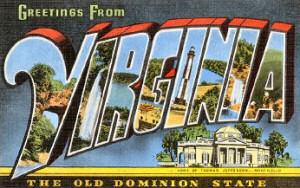
Growing up in Virginia, history lessons were inescapable (except by daydreaming out the window). Cape Henry, the site of the first landing of permanent English settlers in America, was just a few miles from my school. Adam Thoroughgood House, the first brick home in America, was within walking distance of my classroom. Everywhere I turned, someone notable had been tramping around before I got there.
Now that I live in history-rich Richmond, I have a real interest in events from the past. It also helps to be sober, because now I actually get out of the house to go visit historical places. I have deep gratitude that I am surrounded by so many different places that formed the fabric of our nation, so to speak. I am filled with awe to think that I am walking the same streets as Thomas Jefferson, Patrick Henry, Robert E. Lee, and Abraham Lincoln.
During the past few years, I have been exploring the history of the Civil War. Virginia saw more battles during this horrible conflict than any other state. I'm currently plowing through the third volume of The Civil War by Shelby Foote. Today's post is about the night Richmond was abandoned by the Confederate government. Most of this information was taken from Mr. Foote's book, with a few other snippets I've gleaned elsewhere thrown in as well.
Like Rome, it is said that Richmond was built on seven hills. Richmond also burned, like ancient Rome. Much of Richmond was spared, and I've included below a few photographs I have taken of antebellum buildings in the city. I took all of the color pictures - except for the vintage classroom picture at the top - with my cheap digital camera; the black & white pictures are archival photographs taken after the Union troops captured the Confederate capital.
Abraham Lincoln declared that securing Virginia's Capitol, designed by Thomas Jefferson (inspired by the Maison Carrée), was a priority for the Union troops. There were several hours, however, when this building stood unprotected, and it is probable that its lone position at the top of the hill was the only thing that spared it from destruction. The pictures toward the bottom of this post were taken on a visit I made to the Capitol in September.

On a Sunday morning in April, 1865, a telegram from General Robert E. Lee was delivered by a War Department messenger to the President of the Confederacy midway through the morning service as he was seated in his pew at St. Paul's Church. The Confederate head of state left the church immediately, silently. Twelve hours later, Jefferson Davis and his cabinet fled Richmond by rail, and before the presidential train departed the station, the streets of the city were choked with panicked citizens, pillaging marauders, and convicts whose guards had abandoned their posts. Mobs stormed government storehouses seeking food, and looters smashed merchants' windows looking for anything of value they could steal with impunity.

The fall of Richmond was at hand. The Confederate forces were pulling out, leaving only demolition squads behind to begin torching the tobacco warehouses and munitions buildings. The city officials protested, but there was no ranking member of government left to delay the army's orders.

A south wind nourished the flames, and soon they leapt from the tobacco warehouses to the enormous riverside grain mills, the largest flour mills in the world. As smoke and flames belched from hundreds of windows at the Haxall and Gallego Mills, the city was jolted by the explosion of a nearby magazine.
This was followed by a another, much closer, that was described as volcanic in its violence. The national arsenal, with 750,000 loaded projectiles, was being destroyed and the explosions went on for hours. A diarist wrote "the earth seemed fairly to writhe as if in agony. The house rocked like a ship at sea, while stupendous thunders roared around."

Meanwhile, at Rocketts Landing, Admiral Raphael Semmes saw to the destruction of his James River Squadron. When his three ironclad warships blew, he wrote that the sight was "grand beyond description. The explosion...threw all the shells, with their fuses lighted, into the air. The fuses were of different lengths, and as the shells exploded by twos and threes, and by the dozen, the pyrotechnic effect was very fine." The citizens of Richmond, many of them women whose husbands, sons, and brothers were off fighting the war, were likely too terrified to find any beauty in the night's sights and sounds.

By this time, both railroad bridges out of the city were impassable with flames. Only Mayo's Bridge had been kept open for the departure of the rear guard, and barrels of tar and stacks of pine knots placed at intervals along the length of the bridge signaled its imminent destruction. Shortly before dawn, the brigadier of the rear guard saw his troops across the bridge and gave the order to the engineer in charge, "All over. Goodbye. Blow her to hell."

Across the river, a retreating horseman observed "The old war-torn city seemed to prefer annihilation to conquest." The fires on the city's banks had spread laterally for nearly a mile, and the flames were spreading north up the hills toward the heart of the city. Residents were burned out of their homes, and looters had to run with whatever they could carry.

Two days after Richmond burned, Abraham Lincoln made an extraordinary visit to Richmond, about one week before he was assassinated at Ford's Theater. Perhaps I will tell you about that soon. Below are pictures of the Capitol, which underwent a complete renovation between 2004-2007, just in time for a visit from Betty Windsor, Queen Elizabeth II.


 Posts
Posts




 My StumbleUpon Page


5 comments:
Thanks for sharing the history and the pictures.
what an amazing place you live in bill, nz isn't a very old country so we don't have as much history but its fun learning about places around the world.
Fascinating. I need to come round to your hood and do some investigating.
I am really grateful that nodding woman is gone. She creeped me out!
This is so interesting. I love reading about American history and visiting historical spots. On our trip this summer, I was very impressed with how the National Parks system does such a great job in making our history real and bringing life to the experience. Gettysburg is a great example. You live in a fantastic area for exploring.
Your photographs are better than most brochures out there. The one of the capitol at night and the ones of its interior are worthy of the state's archives. I'm so impressed.
Post a Comment