Thursday, April 15, 2010

The One Hundred & Forty Five Year Boat Ride

Spring sprung. It happened fast here in Richmond. For awhile, it crouched like a wild-eyed cat wiggling its backside, positioning itself for the kill. When it pounced, it was quick. My sinuses were the first to alert me that we were under attack.

I endured four days of endless sneezing, but now I've adjusted. I learned years ago that if I take allergy medicine, then I'm stuck taking it. It's better for me to suffer a few days of hell and let my body regulate naturally. I was tempted, though, to stuff tissues up my nose at the office and just let them hang there, daring anyone to say anything. A runny nose is so aggravating.

In an effort to ignore my nose, I roamed around the Fan District taking some pictures. I'm only including a few. The photo at the top shows a camellia blossom. We had those around our house when I was growing up.

The tree immediately above is a saucer magnolia, and their blooms are really spectacular.

Below you'll see Robert E. Lee astride his mount in the center of Monument Avenue. In the distance is Stuart Court, where I lived in the early 80's.

Springtime means that Sadie pulls her plaid boating shoes from the back of her closet and starts humming sea shanties. A boat from her fleet is brought out of storage and delivered to her home, all spruced up and ready for cruising on the James River. The following pictures were taken on Easter Sunday. Sadie, Sheldon & I went down to Hopewell and back.

Appomattox Manor, shown below, sits on the promontory of City Point at Hopewell, and was the Union headquarters during Grant's siege of Petersburg. Here the waters are wide, and the house overlooks the confluence of the James & Appomattox Rivers. Toward the end of the Civil War, when the Union forces occupied this plantation, City Point was the busiest port in the world with an enormous U.S. supply depot for its troops.

Appomattox Plantation dates back to 1635, and the house itself was a century old when Grant used it as his headquarters. President Lincoln was visiting here when the Confederate government fled Richmond after setting it ablaze. On Easter Sunday, it was hard to imagine the calm waters bristling with schooners, packet ships, paddle wheelers, and supply barges.

One hundred & forty five years ago, after the fall of Richmond, Abraham Lincoln insisted upon being taken upriver to Richmond. Grant's staff pleaded against such a risky venture, but Lincoln would have none of it. Two days after the evacuation of the Confederate Capital, Lincoln and his son Tad were aboard the steamer River Queen heading up the same river that that Sadie had navigated. We had no need to worry about mine-laced waters, however, as Lincoln did.

About noon, the steamer encountered a line of Confederate obstructions in the river; sunken objects intended to keep Richmond safe from Union forces. Above this line, many mines remained in the water, but a side-wheel steamer, the Malvern, swept the waters. Also in attendance were a gunboat, and a transport ship holding a cavalry escort and the president's carriage & horses.

Pictured below, a modern-day dock worker sullenly prepares to pump gas into Sadie's boat. Oh, wait, that's Sheldon.

We gassed up, got ice cream, and I bought a t-shirt at Jordan Point Marina. Beyond Sheldon you can see the Benjamin Harrison Bridge, and there's a better picture of it below. The bridge replaced ferry service in 1966, and eleven years later an ocean-going tanker rammed the bridge.

The lift span had been raised for the ship, which meant that motorists were sitting on the bridge in their cars waiting for the vessel to pass. When it became clear that the ship was heading directly for them, people scrambled from their vehicles and ran pell-mell for their lives. Four cars tumbled into the water, but no one was hurt. It took twenty months to repair the bridge. Somehow, Sadie avoided ramming the bridge and inconveniencing commuters. Hats off to you, Captain Sadie!

Next we see a house on a bluff perched on the riverbank. Notice there are trees around the house. In general, there are trees lining the banks of the river. In fact, there are trees nearly everywhere you go in Virginia. One of my mother's cousins from Iowa, en route to our house on vacation, reportedly went temporarily mad in the car somewhere around Williamsburg after riding for miles surrounded by deep woods and screamed "WHAT IS BEHIND ALL THESE TREES???"

I can understand that. In Iowa, if you see trees in the distance, it means farm (a few trees) or town (many trees). Otherwise it's just fields. Ruth was simply thrown off-balance by so many things growing out of the ground that weren't crops.

Sheldon, on the other hand, grew up in Virginia. He's lived here all his life. As we passed by one of the few barren spots along the James, with probably an unsightly landfill over the rise of the bank, he commented on "how pretty that looks." What a weirdo. He & I have been riding in the car together, and he'll say "Boy, I like that house" and when I look, there's a home with not a tree in the yard and about two scraggly bushes huddled up to the house. I think he may have fallen on his head out of a tree when he was little. There's a resentment there somewhere.

On our way upriver, we passed this boat coming down; the Do Run Rum. What a splendid boat.

Going back to Lincoln's journey up this river in 1865, it was near this place that all of the vessels in his flotilla were unable to pass a second line of obstructions; the Confederates had sunk entire steamships to keep Richmond secure. Only a small span remained open. No doubt, the attending officers & crew were relieved.

Until Lincoln insisted upon being transferred to the admiral's barge, which was really just a big rowboat. A small steam tug, with thirty marines aboard to guard Lincoln, took the barge in tow. Lincoln was in high spirits, even as wrecked shipping and dead horses, the detritus of war, floated by.

There's Jimmy Dean the Sausage King's home below, rebuilt after a fire. No pigs visible in the yard.

As we got back to Sadie's place, we passed by the Boathouse Restaurant. In a river town, oddly, it's one of the only places you can dine right next to the James River. Apparently, is used to be a power plant.

On that long-ago journey to Richmond, the tugboat ran aground before reaching the city. Lincoln would continue without an escort. Four ships holding hundreds of sailors & soldiers had been reduced to an open rowboat. Twelve sailors guarded the President of the United States as he walked uphill to the White House of the Confederacy. He had made it safely to the capital of the enemy. Ten days later he would be shot in Washington, D.C. I reflected on the brash voyage of a complex and inspiring man as I looked out on the placid waters of the James River on Easter Sunday.

Here's Sadie's place, preparing to slide into downtown Richmond by the looks of this photograph.

And we end our boat ride with Fisherman Sheldon showing us how not to catch anything at all.

Of course, the next time he was out on the boat, he caught a very large shad. He says. I wasn't there to verify that tall tale. I have to rag on Sheldon a bit; he has a birthday this Friday, and he's younger than me, the bastard.

Tuesday, March 23, 2010

It's a Wonderful Day for an Auto-de-fe'

Last Saturday turned out to be a wonderful day to eat a piece of Hummingbird Cake at Garnett's Cafe.

Last Saturday was also a wonderful day to go to the 25th Annual Irish Festival thrown each spring by St. Patrick's Catholic Church.

Saturday was a wonderful day for a wee colleen to sleep it off in her grandfather's arms.


One night in late October,
When I was far from sober,
And returning with my manly load & pride,
My feet began to stutter,
So I lay down in the gutter,
And a pig came near and lay down by my side.

Now a lady passing by was heard to say,
"You can tell someone who boozes
By the company he chooses,"
...And the pig got up and slowly walked away.
¹


Saturday was a fine day to be in Richmond at the Irish festival. The weather was sunny, bright, and warm. The festival crowd was happy. No one who wanted it seemed to have any trouble finding beer. Vendors sold all sorts of items, with a slant toward Celtic designs and the color green. Funnel cakes were available. The parishioners at St. Patrick's prepared & sold all sorts of good food. Live bands played back to back.

Saturday was a wonderful day for a man to wear a skirt.

Saturday was a splendid day for entire groups of men to wear skirts.

It was a wonderful day for an outdoor festival. The weather was perfect, the police had cordoned off a section of Broad Street and a couple of cross streets. People were everywhere, laughing & talking, drinking & eating, wearing green clothing - some wore silly hats. The beer trucks and portable toilet sheds had endless queues of customers. We needed neither as we threaded our way through the throng of celebrants.

When I see the porta-johns at these outdoor festivals, and the long lines snaking from them, I always think of my friend Kim's encounter with a particular public convenience station. Years ago Kim went to the Strawberry Hill Horse Races, and I asked her about it the next day. She said she had a fabulous time, but that she couldn't get the soap smell off of her hands, and could barely enjoy the splendid picnic her host had packed. I must have looked confused. She explained that the disinfectant soap in the porta-potty had an industrial strength odor that clung to her fingers.

"You mean the portable toilet, one of those haul-away outhouses? Where did it have soap?" I asked, mystified.
"In the little sink, next to where you sit down," Kim patiently explained, as if I had eaten lead paint as a child.
"Did the sink have running water?"
"No, just the soap."
"Yeah, laying at the bottom of the sink, right? Kim, that wasn't a sink. And that wasn't soap."
(horrifying realization in 3...2...1...)
"Oh. FOUL."
"And every man on earth aims for that little deodorizing cake."

I wasn't drinking beer at the Irish festival, so I didn't have to bother with the long, long pee lines.

The photo above shows the spire of St. John's Church watching over the festival. I was hoping Patrick Henry would dash out to the churchyard wall screaming "Give me liberty, or give me one of them there hot dogs with mustard & relish!"

St. Patrick's Catholic is right across from St. John's, and dates back to 1859. The festival, which started as a small affair years ago, has become the city's most popular post-winter outdoor event. No dogs are allowed, but you can bring baby carriages the size of Hummers. What kind of knucklehead brings a baby in a humongous pram to a jamb-packed street festival thinking that it's going to be smooth sailing? Whatever happened to the papoose?

Next we have a behind-the-scenes picture of the busy kitchen at St. Patrick's. Church volunteers work for days in advance preparing food for the festival. Thousands of potatoes are peeled, scores of onions are chopped, and a pasture load of corned beef briskets are cooked. Irish Lasagna is a house speciality; pans layered with cabbage, corned beef, and potatoes. Endless vats of elbow pasta are boiled for macaroni & cheese.

Before we went to the festival on Church Hill, Robespierre & I ate lunch at Garnett's Cafe in the Fan District. Garnett's overlooks a small triangular park. Guarding the pointy eastern end of the park is the Confederate Everyman below. The base of the statue has a lot of flowery language about the courageousness of the fighters (vanquished) for the glorious (lost) cause during the conflict (civil war) with "the Federals." Not for the first time lately, I reflected on the elusive (illusive) nature of truth when writing (crafting) history. I was fed a lot of crap in school growing up.

Garnett's is a tiny wedge of a restaurant, and I doubt that it holds over twenty-five patrons. As you can see in the picture below, at the front end's window there is just enough width for a table for two.

The crust-end of the pie-slice restaurant is wide enough to offer counter service. The food was delicious, and the Hummingbird Cake was definitely made from scratch. My mom used to make those, and this rivaled or surpassed my mother's cake. (please don't strike me with thunderbolts and lightning sorry mom)

The next photo shows the Synagogue of Congregation Beth Ahabah. I took this picture Tuesday evening as I was strolling down to the Landmark Theater to see Wicked, which is blowing through town on tour. Beth Ahabah was built in 1904. Sorry it looks a bit tipsy; I didn't linger long in the middle of the street for the perfect photo.
The synagogue and the following buildings are all in the area of Virginia Commonwealth University (VCU), an urban university. This was an area of fashionable homes at the turn of the previous century. Now, the three homes below, as well as many others, are part of the VCU campus. These blocks of West Franklin Street were once called the Fifth Avenue of the South.

Add Image On one hand, the purchase of these homes in the 1920's through the 1960's during VCU's initial expansion probably saved the buildings from the wrecking ball. The acquisitions, though, provided required space for offices, classrooms, and dormitories. Little consideration was given to historic preservation, resulting in cheaply partitioned rooms, ugly window air-conditioning units, and maintenance based on cost rather than aesthetics.

Millhiser House shown above is perhaps the most exotic home on these blocks, inspired by Moorish design, and built in 1891 for Samson Hirsch who transferred ownership to his brother-in-law, Gustavus Millhiser, in 1894 for $5. The exterior features brick, terracotta, and copper. A polygonal tower erupts from a carved foliated brownstone corbel, and the third floor has a dramatic tripartite round-arch arcade. The interior of the home contains some of the most important decorative detailing of any house in the area, including woodwork, tile, art glass, and fireplace backs that depict Shakespearean & mythological scenes.

The Scott-Bocock House, circa 1909, was designed by Noland & Baskervill, the architectural firm that also designed Beth Ahabah Synagogue. The last occupant was Elizabeth Scott Bocock, local eccentric & preservationist.

The house pictured above was a few steps away from the brownstone that I lived in when I attended VCU. I had passed by my first home in Richmond before I thought to take a photograph, but it is similar to this building.

Rounding the corner at Franklin Street & Laurel, at the west edge of Monroe Park, I walked past the Cathedral of the Sacred Heart on my way to Landmark Theater. Completed in 1906, it is the only cathedral in the world built with the contribution of a single donor, Thomas Fortune Ryan, who had controlling interest in thirty corporations at one point. At the time of his death in 1928, he was the South's wealthiest native son. With a reputation for cutthroat business practices, perhaps he felt that a cathedral was a wise long-term investment.

I thoroughly enjoyed seeing Wicked. It was a wonderful play with an auto-de-fé.


¹ Verse provided by my pal, Linus, from the local Archives committee.

Wednesday, March 10, 2010

A Sunday Stroll Through the Gay Nineties

Richmond basked in the sun this past weekend, and I met Jean & Bruce at the deLux Diner for an early brunch. Afterwards, since it was so pleasant, I picked Morris up and we took a walking tour along Hermitage Road. I had my trusty camera with me, so please settle back and let Morris & I do the walking while you enjoy the photos.

The two pictures above & below are of Holly Lawn, an estate that dates to 1900, built for a fellow named Andrew Bierne Blair. This handsome Queen Anne mansion is one of several estates in a designated historic area along four long blocks of Hermitage Road. We had a fine time gawking at the houses. Because Hermitage Road is a main road leading into town from the north, neither of us had ever walked the area. You can't see nearly as much when you're zooming along in a car.

The northside areas of Richmond were developed as the city became overcrowded, and sanitation and racial issues arose. After the Civil War, while the city rebuilt and became more populated, growth was hampered by the James River and the city of Manchester to the south, and a deep ravine to the north. Only one road, the Brook Run Turnpike, connected the city with points immediately north, and wealthy Richmonders bought up land for large estates. Many still maintained homes in the city, and used these country homes to escape the confines of the city on weekends or summers.

Richmond's inadequate infrastructure had not kept up with the population boom, and residents dealt with piled up garbage, a polluted water supply (Shockoe Creek was basically an open sewer), and coal smoke from burgeoning industries. Those who could afford it sought relief in the outlying areas to the north and west of town.

I don't know about you, but I take a lot for granted, such as clean water.

Lewis Ginter and his domestic & business partner John Pope were the two wealthiest men in Richmond. That's right, two gay men¹ in the latter part of the 19th century held the biggest purse strings in town, and they were instrumental in developing several neighborhoods of middle to upper middle class homes in Richmond's Northside. The Hermitage Road Historic District is in the middle of one such area. Originally the enclave of wealthy & prominent Richmonders, development in the first half of the 20th century brought middle class citizens to the bordering neighborhoods of Bellevue Park, Virginia Place, and Rosedale.

Hermitage Road has a grassy median today, but this was originally where the streetcar ran. The advent of the streetcar, especially when it switched from horse to electric power, was the springboard for expanded development, and Lewis Ginter & John Pope looked forward to this new technology. Although both died before the city's first public streetcar went into service, Lewis Ginter had established his own Lakeside Line which served the residents along Hermitage Road. According to the Virginia Historical Society, Richmond had the first operational electric trolley lines in the nation in 1888, the Richmond Union Passenger Railway.

Ginter and Pope purchased the old Westbrook Plantation, which had been around since the 1770's. They incorporated the original plantation house into their Queen Anne mansion, which was considered one of the grandest homes in the South. Westbrook had dark paneling of birch, oak, cherry and mahogany, parquet floors, and an extensive library. The third floor of one of the towers housed their own barber shop. One outbuilding offered a one-lane, automated bowling alley.

John Pope was also building his own home shown below, which he named Rosedale, but he died² before its completion. The stone arch pictured above marked the lane that ran directly from Rosedale to the Westbrook estate. Unfortunately, I cannot show you any photos of Westbrook, because the magnificent home was demolished in 1975. Richmond, like many cities, endured a period where historic preservation and remembrance of things past were undervalued.

Rosedale, completed in 1897


Wrenford, circa 1896, pictured above and below. The rear yard features several outbuildings, including a very large carriage house.


Montrose, 1898, is the home that spurred the creation of the historic district. When the home was threatened with destruction in 1988, the community rallied to protect the architecture along Hermitage Road.


Shadyhurst, 1899, was built by J. Clements Shafer, private secretary to Lewis Ginter.

The Shadyhurst home originally had six bedrooms, three bathrooms, and a three-room servants cottage. Apparently, Lewis Ginter paid his employees well, which is not surprising. Aside from his wealth, he was known for his generosity. His philanthropic work was on a mammoth scale, and his funeral in 1897 was as large as Richmond had seen. The city viewed his death as a calamity, and mourned the loss of one of its most prominent and generous citizens.

Willowbrook, built in 1925 for the J. Lee Davis family

The Davis family also purchased Shadyhurst in 1915. Willowbrook is now the New Community School. This school provides specialized instruction for students with dyslexia in classrooms that average six students. One of my former employees had a son who attended this school, and he said they do remarkable work.

The Oaks, 1909


Edgewood, 1870 or prior, is the oldest home in this historic district of Richmond.

Lewis Ginter purchased this property in 1889 for use as his land development office and also to house bachelor workers. Later, Ginter gave this home to one of his landscape engineers as a wedding gift. Edgewood's carriage house is shown below.


This could be the world's biggest bungalow. It was built in 1908, according to city property records. You can't appreciate the scale of the home from this picture, and I wish I had a broadside photo of the other side of the structure. It is long, long, long. You can get an indication of the deceptive proportions if you look closely at the front of the house. See the exterior lights flanking the porch's screen door? Figure those to be right about head-height, and you'll get an idea about the immense size of this "cottage." There's a wing off-camera that appears to house a ballroom or reception hall. I wish I could find out more about this big ol' bungalow.

The last photograph is not in the Hermitage historic area at all, but I think it is a charming house. Morris & I were hot and thirsty after our walking tour, so we bought beverages and parked at a church to refresh ourselves. The Victorian cottage shown below was across from the church, and I took a moment to walk over to take a picture.


¹ From Lewis Ginter's obituary in The Times, October 3, 1897: "His manner toward women was tender, considerate, at times gallant, though he never pointedly sought their company."
² According to John Pope's obituary in the Richmond Dispatch, April 9, 1896: "Mr. Pope lived quietly with Mr. Ginter, for whom he possessed the most ardent affection" and that the two "were almost always together."

Sunday, March 7, 2010

Passing It On

There are a couple of things that I really like about this time of year.

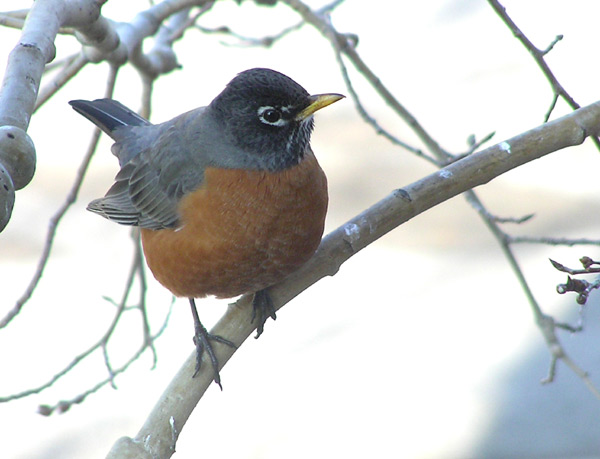
For one, if you're mindful, you start noticing little hints of Spring around here. Small signals that the seasons are changing. I saw a big-breasted robin sitting on a dogwood branch last week. Twig tips are showing tiny signs that they're not dead at all, and are getting ready to start pushing out buds & leaves. Nights don't get quite as cold. I can usually leave the gloves at home. The Evil Topcoat can hang in the closet more often, and I can take a lighter jacket some days. The anticipation of Spring is a feeling of hope.

The other thing I really like (which will change soon) is that the sun comes up so early in the morning. I'm usually out the door a little after six each morning, and the sky is brightening as I drive toward the city. As I have my quiet time with meditation & prayer, I can hear the birds waking up.

The days and evenings are pretty busy, but in the early morning the world is still quiet, and I take time to notice things around me. The paling moon bisected by a thin strand of cloud. Pure, bright sunlight streaming through the pine boughs.

It was a busy week on the phone at the office. A lot of calls from people in pain. Some calls were about relatives who are alcoholics; some calls were from alcoholics who are still suffering. I talk to them all, referring the relatives to Al-Anon, encouraging the others to start going to AA meetings. The disease of alcoholism sickens everyone it touches. Some will get into their own program of recovery, be it AA, Al-Anon, or another source. Many, though, will not be able to overcome the fear of making a change.

They don't realize it, but their calls make me grateful that I am in the middle of recovery. I hear the pain, bewilderment & fear, and I am so grateful that I was given a chance to climb out of that well of despair before my disease killed me. I was at the brink. The turning point became very clear to me.

A woman came up to me at the end of a meeting the other day. She is someone that I happened to talk to when she reached out for help last summer. "Do you have any idea how many lives you have touched with the work that you do?" she asked. I probably had a blank look on my face when I answered her honestly and said "No, I don't."

And that is how it should be. I cannot save anyone; I cannot keep anyone sober. I'm simply a tiny cog in a big wheel. My best moments come when, for example, I am listening to someone weeping, and I think "Lord, what do I say?" in all sincerity, seeking guidance. Then the right words come, when I am humbly asking for help instead of trying to go it alone. The best I result I can hope for is that through some words of hope and encouragement, sharing some personal experience, and a little humor I can reduce their fear and get that caller to a meeting. Because that's where the healing truly begins, and it doesn't matter whether I ever meet that person or talk to them again.

I worked in the office Saturday, and one of my visitors was a tall, handsome fellow named Jim. Saturdays are usually not as busy as weekdays, so he was able to sit for awhile and talk. As we were catching up on each other's lives, I reminded him that he was at the first AA meeting I attended, and he remembered how shattered I looked. This fellow had three DUI's and other alcohol-related offences before he finally came to AA. One time he was charged with "drunk in public" when he was in his own driveway. His life was going down the crapper, but he's doing very well now.

I reminded him that he put a meeting directory in my hand at that first AA meeting I attended.
"Really?" he said.
"Yes, and you made sure I saw all the phone numbers written in the back of the people who wanted to help me."

It gave him goosebumps. We're like that. We love to pass it on.

Wednesday, February 24, 2010

Girls (?) Gone Wild!!!

I can say with assurance that this has been a winter that Richmonders will talk about for years. We're disgusted with the weather forecasts, and just tuckered out from all the snow shoveling and windshield scraping. In the usual scheme of things around here we will have snow followed by a quick thaw, but this winter we've had one storm on the heels of another. My backyard has been covered in snow for weeks.

I've made it to the office every day, though. It's a work ethic that was instilled in me at the age of nineteen when I started working for Worldwide Monopoly. You get to work on time even if it means getting up several hours early to start shoveling & scraping. And why not? What would I do at home except drink coffee, lounge around in sweatpants, and take naps?

Hmmm...I may need to rethink this work ethic.

We're all weary of the snow, because by this time it isn't even pretty snow. We've been getting snowfall in steady pulses since the weekend before Christmas, and even hermits need to leave their homes occasionally for supplies. Parking lots feature miniature Matterhorns; brooding piles of dirty, gray snow obscure visibility. The roads are pocked with hellish potholes, and every car in town will need a front-end alignment by the time spring arrives. So, we're all pretty cranky.

What can you do about the weather except sit around and bitch?

Well, I'm glad you asked, because one alternative is to get a pack of people together and head down to your local Drag Show Brunch, which is what fourteen of us did this past Sunday.

Here's what it's been like around here lately. This picture was taken in my neighborhood on my way home from work one day.

Here's the crowd waiting outside Godfrey's on Grace Street for the drag brunch show. We were all excited because it was a beautiful sunny day for a change.

Robespierre & Martha waiting for the show to begin.


Sheldon enjoying the last heterosexual moment he would have for a few hours with his girlfriend, Sadie.


And now, on with the show!

Warning: this post contains actual photographs of live gender-bending nudity!

You have been warned! Leave now if you are easily offended, unless you have hot coals to poke in your eyes. Remember, being offended is the natural consequence of leaving one's home.


Sheldon cringes under the she-male assault of Tiffany Devereaux. I'd been to Godfrey's brunch a few times, so I chose a spot against the wall when we were seated. I grinned to myself when I saw Sheldon take a seat at the edge of the performance area.


Robespierre, who is always looking for a date, learns to be careful what he prays for.


Tina Turner takes a liking to Sheldon, too.


Entertaining the masses is exhausting.


Mercedes Douglas makes her entrance from Grace Street. There was a bewildered man across the street rubbing his eyes in wonder.


Martha decides to get in the act & earn a few bucks of her own.


Boobs are boobs. Dave is happy.


The performers put on a great show, and we happily gave up our dollar bills to them. They worked hard for the money. We had a blast, and we had the only two tables in the restaurant that weren't littered with booze glasses by the time the show ended. The drag brunch attracts a lot of bridal, birthday and divorce parties, and those folks were really whooping it up.
As we drove away, we saw one puking girl being carried to a limo by her friends. We still had a whole day of fun ahead of us. The sober life is full of mirth.