Thursday, October 9, 2008

Writer's Blockhead

Yoo Hoo! Lookie who's posting an entry on his blog! Don't get your hopes up...it's just a short note to say "howdy."

I'm sorry I have been away from Planet Bill for awhile. Many of you have left comments or dropped a note in my mailbox asking where I have been. I am doing well. I have been taking road trips, answering the AA hotline many hours each week, exploring the city and surrounding areas, adapting to a new job, and spending less time at home. It's been good for me, but I have missed all my blog buddies, so I need to balance my time a bit better.

Here are some of the highlights I want to tell you about soon:

  • touring the Maggie Walker House in the Jackson Ward section of Richmond

  • being tipped off by a friend to a great little restaurant called The Black Sheep

  • an AA meeting we held outside in the rain because we couldn't get inside a church

  • my road trip to Vermont for Cousin Janet's wedding

I also bought my first digital camera (because of Janet's wedding), so you may see my actual photos pop up from time to time. As soon as I get the software loaded on my computer. The photos are accumulating in my camera at present.

Thanks for dropping by, and I'll be checking in on each of you soon. I don't have to work this weekend, so I should have time to roam through the blog universe. In the meantime, have an easy day.

Saturday, September 6, 2008

Blue Stone Cabins

Back in the mid-1980's a friend wanted to buy her first home, and asked me to move in with her to share living expenses. At the time, I was living in Stuart Court on Monument Avenue, and the shock of moving to Oregon Hill is something I'm sure I will cover in a later broadcast. Today I'm thinking of a serendipitous overnight trip that my roommate Virginia & I made across the Blue Ridge mountains into the Shenandoah Valley.

Most of our Interstate highways parallel older, established roads, and I-81 is no exception. It runs alongside Route 11 on a mostly north-south route, anchored at the northern end by Winchester, and Bristol in the southern tip of Virginia. The interstate has, of course, eclipsed Route 11, acting like a younger, more popular step-sister. But Route 11 is where the more interesting sights will be found.

My father told me that Route 11 was once called "The Broadway of the South," because it passes through Virginia, Tennessee, Georgia, Alabama, Mississippi, and Louisiana, ending in New Orleans. Broadway of the South it may have been, but north of Virginia it continues through West Virginia, Maryland, Pennsylvania, and New York, where it adopts a different number when it crosses the Canadian border near Rouses Point.

Interstate highways bore me to vexation, and I avoid them unless I am truly strapped for time. They are monotonous, dull, and have no soul. The older highways offer glimpses of the wonder of touring by car in times past. Here, I get a sense of history, and understand the unique flavor of each section of the state I am passing through. Most of us are so obsessed with getting there that we forget that the journey is often the most splendid part of the experience.

Okay, okay, enough of that. I'm supposed to be writing about the weekend road trip that Virginia & I took. We headed out of town on Route 250, through Charlottesville, waving hello to Tommy Jefferson's Monticello and the Rotunda at the University of Virginia, and crossed over Afton Mountain. At Staunton (with a wave and a yawn to Woodrow Wilson's birthplace) we turned north on Route 11 and meandered up the Shenandoah Valley.

We poked around Harrisonburg, ogled the cute James Madison University students, and found a diner downtown for a lunch purchase. Back on Route 11, various antique shops offered leg-stretching opportunities, and we stopped at a ramshackle shed that was surrounded by acres of the tackiest yard ornaments we had ever seen. It was all there in cement, the garden gnomes, lawn jockeys, saints, deer, kissing Dutch boys & girls, and uncomfortable benches that promised a souvenir case of piles if you sat on them too long on a cold day.

Outside New Market we saw a bewitching sign floating on a Blue Ridge mountainside to the east. Endless Caverns it proclaimed, looking like our Commonwealth's response to the Hollywood sign above Los Angeles. We took a neglected road that led to the sign, and as we drew closer, the trees encroached so that all we could see framed between the boughs was ENDLESS. Now offering tours once again, the caverns were at the time boarded up and abandoned, and the road ended at a chained gate.

By now dusk was settling into the valley, and we decided to find lodging, preferably at a cabin court or a Norman Bates motel. We eschewed more comfortable and modern establishments in favor of the Blue Stone Cabins, a string of tiny cottages behind a roadhouse restaurant dating back to the 1920's. After we checked in, we headed out for a southern-style meal at a family operated restaurant, and returned to our miniature home-away-from-home.

It certainly was little. The bathroom looked like an add-in, and it invaded the front half of the room, resulting in an L-shaped bedroom with twin beds mashed in however they would fit. A space heater offered comfort from the cold winter night, along with the likelihood of incineration or asphyxiation. There was a strange cannister apparatus attached to the outside of the bathroom wall. The bathroom itself, which loomed large in the bedroom, was quite cramped upon inspection. First came the sink, immediately followed by the toilet, and then a shower stall. The commode was conveniently close to the opposite wall so that a fellow could rest his forehead if sitting upright proved too taxing, and entrance to the shower stall required a large step over the toilet bowl.

We fell asleep as the heater clicked and wheezed threateningly, and I was the first to awaken the next morning. This was not unusual; I'm a morning person and Virginia is a direct descendant of Rip Van Winkle. I brushed my teeth and hopped (literally) in the shower. The hot water felt wonderful, because our wee heater was no match for a winter night. Just as I rinsed off the last bit of soap & shampoo, the hot water turned arctic cold in a split second. I leapt reflexively over the toilet and landed in front of the sink, wide-eyed and startled utterly awake.

When I exited the bathroom, Virginia was just stirring.

"How was the shower?" she yawned.

"Great!" I assured her, eyeballing the mysterious cannister, which I now realized was Thumbelina's water heater.

As I got dressed in warm clothing, Virginia shuffled into the bathroom. I sat on my bed and waited.

Sink noises. Toilet flushing. Shower curtain drawing closed. Almost show time.

The shower thundered for a few moments, and then a piercing shriek split the Shenandoah Valley. I clutched my sides and rocked with suppressed laughter. I barely composed myself before Virginia, her platinum hair obscured by shampoo suds, shot out of the bathroom like a cannonball.

"What's wrong?" I queried, my voice smooth with concern and innocence.

Virginia was nearly incoherent with shock, and I reflected with satisfaction on the numerous mornings that she had beat me into our bathroom at home. Her showers were long and languid, and I knew all too well exactly how she felt as she stood in the middle of the floor, teeth chattering, clutching a bath towel for lack of hot water.

Friday, September 5, 2008

Jamaican Jive Talkin'

Last Wednesday, after a long day at work with no lunch, I called my friend John and arranged to meet him for dinner. I knew I would be too tired to prepare anything nourishing when I got home, so we agreed to meet at a place we were curious to try. The Phoenician serves Mediterranean food, and our favorite place, The Grapeleaf, had suddenly closed recently.

The Phoenician is only a few blocks from my office, and it sits on a stretch of Broad Street so familiar to many American cities. A miles-long succession of blocks built in the post-WWII years, filled with automobile dealerships, fast food huts, non-descript agencies and bland storefronts. Harsh and ugly in the bright sunlight; gray and dreary in the rain. Nevertheless, the Phoenician has received favorable reviews, and I was hungry enough to "eat the ass-end out of a skunk" as my redneck friend Ronnie would say.

I parked behind the restaurant in a parking lot across the alley, and took up a position leaning against a half-wall where I could see the side lot and the back lot. I figured this would let me watch for John, whichever spot he chose to park. I was soon joined by a healthy-looking woman who ambled across the alley. In a mellifluous voice, she introduced herself, told me she had just arrived from Jamaica the previous day, and was in my city to do the Lord's work. She seemed filled with island good cheer and optimism. She then asked me if I went to church.

Me: I'm in a church at least six times each week.

Jamaican Pilgrim: Really? Is good. What church?

Me: I go to several.

Jamaican Pilgrim: What kind?

Me: Oh, Episcopal, Methodist, Presbyterian.

She then reminded me that she came here to do the Lord's work, and was about to share something important with me when a man came down the alley from a Chinese restaurant which sits beside the Phoenician. He held an eggroll wrapped in waxed-paper, which he offered to our Jamaican guest. Much like an old computer, she seemed to freeze. Her mouth slammed shut and her eyes glazed over, staring into some unknown place, perhaps her homeland. She appeared to be in a trance, remote and unreachable. Still, the man persisted to offer her the eggroll, which she did not acknowledge. Finally, bewildered and disgusted, the fellow returned to the back door of his restaurant.

Our island guest snapped out of her trance, and eagerly told me that the Lord had told her to come to this alley to find food, and that when she saw me she knew that the Lord had sent me to her. She explained that she could not take the eggroll, because she had asked him for help and the man had refused her, so when he approached her this time the Lord told her not to accept his help. But she could take money from me.

Me: That's a shame. I just saw the Lord send someone to you with food, and you refused it.

Jamaican Pilgrim: Oh, but I could not take it. I need food from the gas station on the corner, but I need money from you.

Me: No.

Jamaican Pilgrim: You won't give me money for food so I can eat?

Me: No. Good luck.

The Lord works in mysterious ways.

Saturday, August 23, 2008

Stuart Court, Chapter Two

Prior to moving into Stuart Court, the imposing apartment house at the entrance to Monument Avenue, I decided to rent a carpet shampoo machine and do some other general cleaning while my place was still empty. I pulled up in the circular drive at the front of the building and unloaded the carpet cleaner, and before I could take off to find a parking space an elderly - but sprightly - black gentleman dashed out to my car and began lugging the machine into the building. I was alarmed, because he looked like he was a thousand years old, and told him I would carry my stuff in as soon as I found a parking space. He would have none of that, and so he hauled my things into the building.

Mark was one of several black employees at Stuart Court, and he usually worked nights and weekends. During the week, two women acted as hostesses. I quickly learned that I had entered a time warp at Stuart Court, and that many of the old women who lived there treated the staff like servants (or worse). Mark was accustomed to hauling packages inside for the residents.

There were two halves inside one unified front as far as the physical layout of the building. Basically, the building was actually two apartment towers with separate sets of elevators. All of the even-numbered apartments were in the northeast wing, while the odd-numbered apartments were in the southwest wing. The elevators were, incredibly, still hand-operated, so there were two hostesses by day. Rosa staffed my side of the building, and at night Mark handled the whole building. This arrangement probably worked fine until young folks like me moved in.

I'd come in late at night, half-lit, and ring the bell to get into the building. Eventually Mark would appear, half-asleep, to take me up to my floor. Mark told me that he was eighty-six and also worked a day job. I'm sure he was accustomed to sleeping at night at Stuart Court, with only the occasional interruption if an elderly tenant had to call an ambulance in the wee hours.

Dead on his feet, Mark would propel the elevator toward the sixth floor, usually overshooting the goal, then we'd lurch down too far, and I'd step up or jump off just to get on firm footing. I always felt bad about waking Mark up late at night, but that's just how it worked. I couldn't run up and down the stairs all the time.

It was nice having day staff available to accept packages while I was away at work. There was also a dry-cleaning service who visited the building at least once a week, and I could leave a check with Rosa for Mr. Collins, and she would place my clean garments on hooks in the mail room. At the time, I wore a lot of dry-cleaned clothing to work, and this was a real time saver.

After awhile, the old elevators were replaced with new automatic lifts, and the night porter was no longer needed. The day hostesses were kept, but residents got keys to the front door for the evenings.

As the older tenants were removed to nursing homes or cemeteries, the lifestyle at Stuart Court gradually changed. Sadly, the building was sold to a careless owner, and a few years ago this once-proud building was featured on the local news because of the poor condition of the building. The new owner did not seem to care that he possessed a piece of history designed by one of the lauded architects of luxury homes in the early half of the last century, William Lawrence Bottomley.

Below is an excerpt from a review of a book, The Architecture of William Lawrence Bottomley, by Susan Hume Frazer:
Refined country houses, gracious urban dwellings, posh Broadway cafés, exotic nightclubs, and a high-rise apartment building that, 80 years after its construction, is still considered the epitome of tony living in Manhattan, these are among the many achievements of William Lawrence Bottomley, one of the best American architects of the first half of the 20th century. During his 40-year career, Bottomley designed and executed over 180 commissions for his clients. An uncompromising perfectionist with refined taste, he oversaw virtually every facet of his projects, from interior ornamentation and decoration to the surrounding landscape design.

Saturday, August 9, 2008

Car and Driver

Four people who didn't know each other very well were talking at a party. Jason, who had recently obtained a new car, was telling the others about how much he liked it. He had never had a car before, and was excited about his new sense of freedom. He described how his car did things for him that he hadn't even known it could do when he got it. To hear Jason talk, you'd think he was the first person on the planet to drive a car.

Mary listened to Jason, and thought about her own car. She had had it quite awhile, and as far as she was concerned she planned to keep it. Although she didn't speak of her car - she just let Jason talk - she reflected to herself about how safe and comfortable her vehicle made her feel. Even though it had a lot of miles on it, it seemed as good as new to Mary. She was very content, but Mary didn't try to talk anyone into driving a car like hers.

Sam hung on Jason's every word. He was driving a car that belonged to his parents, but had secretly been thinking of giving it back to them, and making his own choice. He knew this would cause a ruckus, especially with his dad, who always thought he knew what was best for Sam. The truth was that his parents' car just didn't have the right feel to it, but he hated to cause trouble in his family. Sam wondered whether Jason's car would be a good choice for him.

Bruce was irritated as he listened to Jason talk about his damned car. Bruce didn't think anyone needed a car, and he always got edgy when the topic came up. He had been injured in a collision between two vehicles when he was young, and had been a loud opponent of them ever since. It angered him to hear how easily car owners went places he could only reach with a struggle. Having had enough of the conversation, Bruce left the party in a huff.

Now read this vignette again, replacing the car with whatever you call your Higher Power.

Earlier this week, I had the duty of answering our local AA Hotline. I got a call from a fellow who said he needed help with his drinking problem. He wanted me to find a meeting near him. I told him about a few, and he asked "what kind of meetings" they were. I explained that one was a speaker meeting, another a discussion meeting, anf the third was a book study. He said he wouldn't go to the book study because they would talk about God.

Hmmm, I thought. It's actually likely that the word God would come up in any or all meetings at least once. Although he had said he had not been to a meeting, I asked him again if he had been to AA before. He admitted that he had several years ago, but couldn't deal with the "God stuff."

I reflected that I had felt the same way when I first went to AA. I was, however, in such despair that I went anyway. I had tried to quit drinking on my own with no success, and the progressive nature of the disease had brought me so close to death that I was willing to try anything. I figured I'd just go see what AA had to offer, and I'd deal with the "religious crap" somehow. Oddly enough, it wasn't a problem at all since AA's steps are presented as suggestions, and you work through things at your own pace. I was also relieved to discover that no one in the program tried to define what my Higher Power should look like.

The best thing I could think of to tell this fellow was based on my own experience with getting sober. I told him that I knew how he felt, that I had felt the same way, and that the steps in the program were suggestions for recovery, not commands. I explained a little bit about what life was like before I got sober; the promises to myself that I would not drink the next day, and the compulsion that drove me back to the bottle each new morning. The awful realization that I could not stop on my own. My fears about my future, and the near certainty of death.

Here's how I reasoned it out, I told him. I finally had to admit to myself that I could not stop drinking. This made me powerless over alcohol. Therefore, alcohol was my higher power. This was, frankly, too screwed up to endure. So I gave in and turned to AA. I went in with an open mind and complete willingness. I let go of my fears and relaxed, and that's all I needed to do. I advised him he could take or leave whatever he heard, but he should go to a meeting since he'd had the courage to pick up the thousand pound phone to call AA. This seemed to make sense to him.

I hope he went to a meeting. I rarely know what happens to people after I answer the hotline. I do my best, and then I must let it go. Sometimes I do see them in meetings, or I will hear about them from others in the program. Alcoholism is cunning, baffling, and powerful; it will use our fears of appearing weak to others, our fears of religion, our fears of losing relationships, and our fear of change to prevent us from getting help. Sadly, the noise of those fears keeps many from getting the help they need.

Monday, July 28, 2008

Strange Interlude

One day, our next door neighbor, Mrs. Ranhorne, was summoned to her front door by a knock. When she opened her door, I thrust a naked doll at her and said "Here, you take this doll baby. It's naked, and I can't play with it no more." Then I marched off toward home.

I was probably three years old at the time, and although my mother tried to keep an eye on me, I was lightning-fast and very sociable. I liked to make the rounds. My folks would wake up some mornings to find I had already visited several neighbors. When the Munsons over on Farrington moved away, I was the first in the neighborhood to welcome the new owners, Bill & Sylvia Harris. I had to stand on their aluminum milkbox to reach the doorbell, but I beat the Welcome Wagon by several days.

Mr. and Mrs Ranhorne lived next door, and were quite a bit older than my parents. They had a son who was grown and lived in another section of town. Mr. Ranhorne died when I was still a little boy, and I remember visiting them with my mother when he was sick. He had cancer of the larynx, and had endured a tracheotomy. I stared at him with wide eyes as he smoked a cigarette through the hole in his neck.

Before Mr. Ranhorne died, he and his wife were sitting in their den when they heard ghostly piano notes coming from the other side of the kitchen's swinging door. When Mrs. Ranhorne ventured to investigate, there I sat on the piano bench, fingering the ivories.

After Mr. Ranhorne died, Mrs. Ranhorne was lonely for awhile, but then she found a boyfriend named Smitty. Smitty drank a lot and didn't fit in with the neighbors, but everyone figured if he made Mrs. Ranhorne happy we'd all put up with him. Smitty would try to mow Mrs. Ranhorne's lawn, but it never worked out well.

Smitty would careen around her yard, always sitting side-saddle on the lawnmower, clutching a beer in one bony hand and trying to steer with the other. After a few loop-de-loos and random patterns, he'd get bored and disappear into her house to pass out, leaving her yard a half-mown mess. My mother would sometimes go over to finish the job.


Saturday, July 19, 2008

Movable Stairs & Dead Chivalry

I've discovered escalators in the 1950's office building where my office is located. They are hidden behind some doors in back of the elevator bank. Do you remember that weird pinky-beige that was so popular in the late 50's and early 60's? If you do, then you know exactly what these escalators look like. They are in an enclosed stairwell of sorts, and I guess they just rumble along all day, although few people seem to use them.

They came in very handy over the past couple of weeks, because the elevators were verplunkt. First, one elevator broke down, and then, in a sympathetic gesture, the second elevator followed suit. There is a third set of elevator doors, but rumor has it that there is no actual lift, and that the builders just put them there to add an air of solvency and prosperity to the railroad company that occupied the building initially. Finally, the escalator between the first and second floors joined the fun of the mechanical strike. The freight elevator was pressed into passenger service.

Many people grumbled about taking the freight elevator, especially Jessie from Building Maintenance because he had to run the thing up and down all day long. I just took the stairs or the escalator, although I did take Jessie a piece of chocolate cake one day to keep his spirits from flagging. The odd thing is that the moving stairs only go up to the fourth floor, and my office is on the sixth. I conjecture that originally the lower floors were staffed by secretarial pools and general office staff, so they were told to ride the escalators, while the executives took the elevators to the upper levels. Who knows?

I loved escalators and revolving doors when I was a small child. From my vantage point in a department store, I could see the on/off buttons at the base of the escalators, right below where the thick rubber handgrip disappeared. I always itched to switch the machinery off, but the fear of consequences kept me in check. I was also afraid that my shoes would get sucked into those toothy grooves at the end of the ride, and my feet would be mangled. It was part of the thrill of disembarking. It paid to be nimble.

Another thing I remember about shopping with my mom when I was little is the small bells that were scattered through some departments below a sign that said "Ring Bell for Service." I caught hell for that one.

My cousin Janet tried to enlist Aunt Magenta's help with the wedding invitations. Janet has selected them and an order is in preparation for shipment. Janet thought Aunt Magenta could help from home by assembling the invitations, and stamping & posting them. This task, which appeared so deceptively simple at first glance, became such a mare's nest that I offered to accept delivery at my office. I'll do the stamping and mailing, which will be no bother at all for me. I get package delivery all the time at work. I got a breathless note from Aunt Magenta along with the stamps, cautioning me to have the post office weigh the invitations to be sure they will not require extra postage. Noted.

The other day as I was returning from the bank to the office, I noticed a woman ahead of me a ways down the hall. She was, I can only assume, returning to her workplace from the ladies room. She wore slacks, and a blouse intended to hang loose all around. A casual, professional look. The problem was that half of the back of her blouse was tucked into her underwear. As I debated the wisdom of hollering "Hey, lady! Your blouse is stuck in your drawers from your trip to the loo!" she disappeared into the office across the hall from mine. Thank goodness! I don't know her, and she may have been mortified to see me ever after. She works in a suite of off-site university offices with several other women, and I'm sure one of them was happy to smugly point out her wardrobe malfunction. I'm still not sure if I was chivalrous, or merely shirking an unpleasant act of decency.

Oh, and the coolest thing about taking the stairs occured to me after one of the elevators was repaired. Just a little over a year ago, I was too weak from malnourishment and alcohol abuse to make it up the stairs in my own home. I am grateful that today I have the good health and stamina to walk up to the sixth floor. So I still take the stairs a couple of times each day.

Saturday, July 12, 2008

A Stressless, Strapless Wedding

My cousin Janet is planning her wedding, which will take place this autumn. Janet and her fiance live several time zones away from Janet's mother, my Aunt Magenta. Although the romance between Janet and Brad has been smoldering for nearly thirty years, the relationship flamed a few years ago. Brad's proposal came suddenly and unexpectedly a couple of weeks ago, so Janet is planning a small wedding in a hurry. Everything is falling into place beautifully, mainly because Janet is focusing on the outcome instead of fussing over the inconsequential effluvia.

Enter Aunt Magenta.

My aunt is a delight to know. We talk on the phone from time to time, and I always find her intelligence and inquisitive nature stimulating. She's very detail-oriented, however, and it is killing her that she cannot provide more assistance with the wedding plans. The wedding will be at Point A, Janet lives at Point B, and Aunt Magenta is located at Point C. Hundreds of miles separate each location.

To be blunt, my aunt has control issues. Giving her information is like handing over a loaded gun.

Janet is handling everything skillfully from afar - invitations, gown selection, catering arrangements, reservations for the big event and guests' lodging, and more. But she is slowly losing her grip on sanity because of the barrage of questions from Aunt Magenta. To be fair to my aunt, Janet is her only child, and this is her baby's first wedding.

Aunt M's queries and cautionary advice seem to pop in just when they are least helpful. I told Janet that the Good Lord aligned the stars & moon so that she would be far from Aunt Magenta until the wedding weekend. Otherwise, there would be bloodstains all over the wedding dress when she walks down the aisle. "Imagine what it would be like if the two of you lived under the same roof as these wedding plans develop," I told Janet. Here's what comes to my mind:

(2:30 a.m. A dark bedroom)

Aunt M: (tapping softly but insistently - sotto voce) Jannie? Jannie, are you awake?

Janet: mmph...wha???

Aunt M: Oh, good. Listen, when you called the caterer today, did you remember to ask her about the napkins? Because I was remembering the napkins at Dottie Chrysler's rehearsal dinner. They were scratchy and they smelled - I don't know - musty...like they had been bought at a surplus store. You know there was a paper mill outside New Orleans that was devasted by Katrina, and I wondered if some distributor bought them cheap and resold them to Dottie's caterer. You know things like that happen, don't you? Well, never mind, you're using cloth napkins, but they could still be musty.

Janet: glrgh

Aunt M: I know, it's criminal. The things people get away with, it really makes me angry. What did she say about the beef? I'd rather she didn't serve beef, but if she is you should ask where it comes from.

Janet: blorfmg

Aunt M: I don't just mean who she bought it from, either. I'm talking about provenance. They track all the cows now with micro-chips or something, so she should know these things. That Mad Cow disease hasn't really gone away, you know. Oh, God, I just wish Brad didn't eat beef, Janet! It really worries me! Have you told him how it affects the filtration system? It just wears the body down. He should pay more attention to these things. He's a smart man, so I just can't understand why he doesn't care about his diet.

Janet: Mom...please...

Aunt M: Hey, listen, wasn't it unbelievable that the post office workers were so rude about selecting those stamps? I mean, this is important, and if you can get prettier stamps of lesser value and combine them on the envelope...well, they should know that these things take time to decide. They really need more postal workers at that station.

Janet: Mom, I'm exhausted. What time is it?

Aunt M: Oh! Let's see...here, let me flip this light on...

Janet: (screeches - throws covers over head)

Aunt M: Oh, it's nearly three in the morning. Janet, you should get to sleep. We need to be up early tomorrow to see about that veil. I still say it should be Italian lace, and that was NOT Italian lace, no matter what they said. Let me tell you, when I stayed at that convent outside Rome in 1953, I saw what Italian lace looks like.

Janet: (weakly) Mother...the light...please, please, turn it off.

Aunt M: Well, I just turned it on because you asked for the time. It's late. Go to sleep. I'll ask you about the peau de soie pumps in the morning. I'm still thinking more eggshell than cream, but it's your wedding.

Janet: I'm wide awake! Let's talk about them right NOW!!!

Aunt M: Jannie, I'm tired, I need to get some sleep.

(Note: the names have been changed, so that I cannot be sued)

Sunday, July 6, 2008

McSick

I've been transcribing more of my mother's diary entries onto her blog today. I'm up to March, 1964, now. At this point, my grandparents are visiting from Iowa, and here's how a Friday in March reads:
Hank came home at 9:30 & got Billy - took him to base for haircut - we went to Roosevelt Gardens Shop. Center to Woolworth's & Rose's - ate dinner at McDonald's - then went to Miller's - Billy messed his pants in there - after coffee Mom, Billy & I went to Ship's Serv. & the Commissary - Billy messed his pants twice more - Mom was sick tonight - We were suppose to go to Dearmon's & called it off -
Probably a good call, Mom, unless the Dearmon's had those clear plastic slipcovers on their upholstered furniture. I'm guessing that McD's was the culprit since Grandma got sick, too. In March '64 I would have been four, and I went through the hair-raising diary entries about my potty training quite awhile back. When I was transcribing those dreary days I thought I would scream if I read "Billy messed his pants" one more time, and - damn- it turns up again like a bad penny.

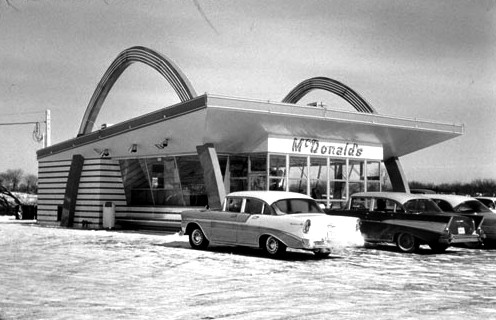
I haven't eaten anything from McDonald's for at least a year, although there's a brand new one close to my home. It's constructed in the hamburger kingdom's latest architectural style. In 1964 the McDonald's in Tidewater looked like a bathroom turned wrongside out, all white tile with red tile accents, and two golden arches soaring over the sides of the building. There was no indoor seating. There were no Big Macs, QuarterPounders, McRibs, McMuffins, Hamburglers, or psychotic clowns wearing bright red wigs. You had a choice of a hamburger or a cheeseburger, one size (tiny by today's standards) bag of French fries, and a small soft drink.

There were a few outdoor tables, but we usually ate in the car. My parents kept an aluminum serving tray under the front seat so that my food wouldn't get smeared all over the red vinyl upholstery of our 1963 Mercury, and after I ate my mother would whirl around in her seat to reach back and give me the dreaded 'spit bath.' Ugh!

My grandparents probably thought that McDonald's was a treat, because I doubt that even today there's a fast food chain establishment in Grundy Center, Iowa. When we visited Grundy County when I was growing up, the nearest McDonald's was thirty miles away in Waterloo. Iowans preferred Maid-Rites, and I do, too. On my last trip to Iowa for a family reunion, my cousins took me to Taylor's Maid-Rite in Marshalltown. I had a Maid-Rite and a butterscotch milkshake, and they were so good that I would have slapped my grandma if she hadn't already taken the dirt nap.

On my 1999 trip to Spain, there was a McDonald's under construction in Almunecar. Suzanne would hiss everytime we drove past it, but once it opened the Spaniards flocked to it. I guess it's a good thing. After all, why should America corner the market on grossly obese children on the fast track to diabetes?

Saturday, July 5, 2008

Stuart Court, Chapter One

One of my favorite former residences is a 1920's apartment house on Monument Avenue. I moved into Stuart Court when I was in my early twenties, and I felt like I had truly arrived when I took possession of my sixth floor apartment. When I first left my parents' home, I moved into a spacious but decrepit house with three roommates. In less than a year, I moved to an apartment with one roommate, and about a year later another relocation placed me in my own small apartment in a modest twelve-unit building in the Museum District.

One summer, Suzanne and her roommate Andy decided to move to Richmond after classes ended. They were both students at the University of Virginia in nearby Charlottesville, and the two came to Richmond to hunt for an apartment. I helped them look for a home, and we took a look at an apartment at Stuart Court. The apartment was unsuitable for them, but perfect for me, since it only had one bedroom. I realized that I would have to act quickly to claim this unusual opportunity, so I arranged to sublet my small two-bedroom place to Suzanne & Andy.

When Stuart Court was built in 1924, it was the sole high-rise apartment building on swank Monument Avenue. Today, it is still only one of two. The stone pediment above the front doors is carved with STVART COVRT. I was enchanted with the apartment as soon as I saw the living room, which was spacious and had lovely wall sconces instead of overhead lighting. My favorite feature in the room, however, was the Murphy Bed hidden behind double-doors. The bed had arched matching headboard and footboard when pulled down from its hiding place, and provided an instant guest bed. This solved the one-bedroom problem, since I often had visitors from out of town. Although very practical, it also added a touch of whimsy to the apartment. Scenes from old Laurel & Hardy movies flashed through my mind, but the bed never sprang back into the wall in the night trapping an unsuspecting sleeper.

The dining room was small, but seemed roomy because of built-in cabinets and two walls of knee-to-ceiling casement windows. The room was also five-sided, which added to its charm. Since my sixth-floor dwelling was three storeys above any nearby building, there was usually a good breeze and always a panoramic view. I could easily see the city's baseball stadium, and on Independence Day my guests and I could watch the fireworks from my dining room table.

Another valuable feature, unusual for apartments in Monument's historic district, was the abundance of closet space. There were five good-sized closets, which was a luxury in a one-bedroom unit from this era. I also had storage space in the spooky, rambling basement of the building, and I will describe this cavern in another chapter about Stuart Court.

The galley kitchen was small, but made efficient by ample glass-front cabinets with pull-out cutting boards, and doorways to both dining room and hallway. Although the kitchen was smaller than the one in my previous apartment, it was more thoughtfully designed and usable.

The building was sturdily built with poured-concrete walls, both inside and out. An axe-murderer could have been hacking up my neighbor as she screamed for help and I wouldn't have heard a thing. My apartment was a serene oasis high above Monument Avenue. When I first moved into the building, the upper floors were reached by hand-operated elevators which required a twenty-four hour staff, including two uniformed hostesses by day and a night porter. Life at Stuart Court was like a step back in time, and I will write more about the building, the renowned architect, and the eccentric residents and staff on another day. Day to day life at Stuart Court was anachronistic when I lived there in the early 1980's, and, although the building still stands, this lifestyle is now part of the building's magnificent past. I am very fortunate to have lived there before its notorious decline.

Accompanying photographs:
Top: Stuart Circle, showing the statue of J.E.B. Stuart on lower right and, above the statue, Stuart Court's south wing and part of the central portion of the building.
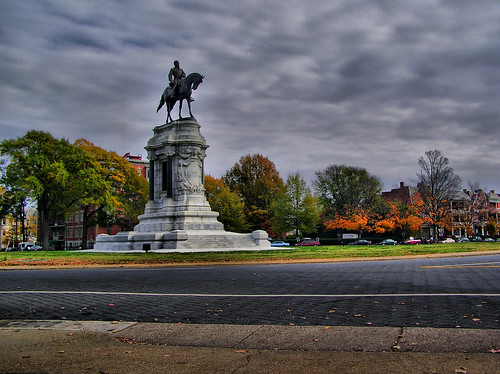
Middle: Robert E. Lee's monument on Lee Circle, one block west of Stuart Court
Bottom: Stuart Court as it appears today.